AI Is Moving Fast. Are Defences Keeping Up?
99% use or pilot AI, while 85% experienced an AI-related cyber threat. Find out what the top AI-related threats are.
In the age of AI, is the attack surface growing faster than cyber resilience?
See how businesses in India are responding to AI threats and emerging cyber risks.
Insights from cybersecurity leaders across enterprises and SMBs in India.
85%
of Indian organisations were hit by an AI-related cyber threat in the past year.
See the AI threats businesses faced and how organisations are responding.
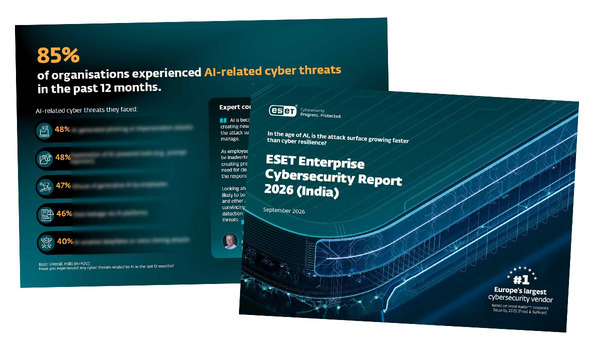
The ESET Enterprise Cybersecurity Report 2026 (India) reveals how prepared local organisations are for today’s cyber risks—from detecting and responding to incidents to addressing skills gaps, budget constraints and emerging AI-related threats. Based on insights from Indian businesses of all sizes, the report highlights the gap between confidence and readiness, where vulnerabilities persist and the investments security leaders should prioritise next.
See how your security priorities compare with other India organisations.
Learn what slows detection and increases business impact.
Turn the findings into clear priorities for people, process and technology.
99% use or pilot AI, while 85% experienced an AI-related cyber threat. Find out what the top AI-related threats are.
80% experienced a major incident; 44% of those affected faced at least three. Learn more about the top challenges that organisations face.
30% of cybersecurity incidents are linked to user actions or human error. How much training is sufficient?
MDR is one of the top cybersecurity measures that organisations plan to adopt.
Almost all organisations face insurance-related challenges. Find out the top reasons.

AI, cloud services and connected digital ecosystems are creating new opportunities, but also expanding the risks organisations must manage. Cybersecurity is no longer only an IT concern. It is fundamental to business resilience and trust.
To understand how organisations are responding, ESET commissioned the ESET Enterprise Cybersecurity Report 2026 in partnership with Blackbox Research.
The findings show that despite growing investment, many organisations still face delayed threat detection, operational complexity and persistent human risk. These challenges are increasingly interconnected and require a coordinated response.
At ESET, we believe the strongest defence begins before an attack. A prevention-first approach—supported by visibility, actionable threat intelligence, effective governance and expert support—helps organisations identify risks earlier and reduce their potential impact.
We hope this report helps leaders make informed decisions, strengthen resilience and move forward with greater confidence.
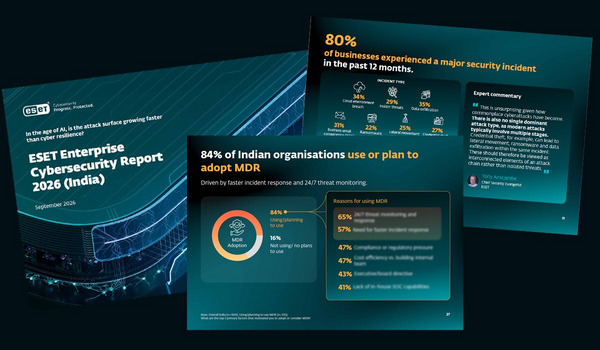
85% of Indian organisations were hit by an AI-related cyber threat in the past year. Reported threats include AI-generated phishing or impersonation, data leakage through AI platforms, deepfake or voice-cloning attacks, exploitation of AI-powered tools and employee misuse of generative AI.
84% of Indian organisations currently use or plan to adopt MDR. The leading motivations are 24/7 threat monitoring and response, cited by 65%, and the need for faster incident response, cited by 57%.
Among organisations that experienced a major incident, the leading causes were lack of visibility across the IT environment at 42%, third-party or supply-chain compromise at 40%, weak or compromised passwords at 38%, and limited security resources or skills shortages at 38%.
97% of Indian organisations face challenges obtaining or maintaining cyber insurance. The most common are stricter security requirements from insurers at 50%, difficulty demonstrating cybersecurity maturity at 49%, complex application or renewal processes at 47%, and rising premiums at 46%.
Among organisations that experienced a major incident, 35% reported temporary downtime or recovery costs as the biggest impact. A further 16% faced legal or regulatory penalties, 15% reported significant financial loss and 12% experienced reputational damage.
Complete the form to access the report and explore the findings shaping cybersecurity priorities across India.